
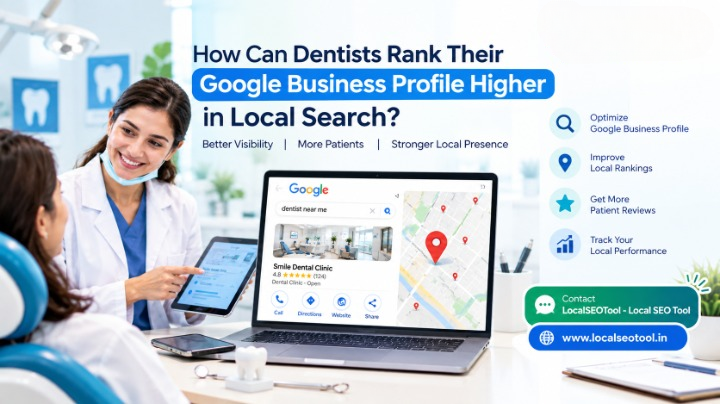
When people need a dentist, they often search on Google using phrases such as “dentist near me,” “best dentist in [city],” or “dental clinic near me.” Google may then show local businesses through Google Maps and the local results section. For a dental practice, appearing prominently in these results can help potential patients discover the clinic when they are actively looking for dental services.
This is where Google Business Profile optimization and local SEO for dentists become important.
A well-maintained Google Business Profile can provide useful information about a dental practice, including its location, services, opening hours, reviews, photos, website, and contact details. However, simply creating a profile does not guarantee a high position in local search.
Dentists need to build a consistent local SEO presence and keep their business information accurate and useful.
Why Is Local SEO Important for Dentists?
Dental services are strongly connected to location. Someone searching for a dentist usually wants a clinic that is accessible from their home, workplace, or nearby area.
For example, a person may search:
- Dentist near me
- Dentist in Ahmedabad
- Dental clinic in [city]
- Root canal dentist near me
- Pediatric dentist in [area]
- Cosmetic dentist near me
- Emergency dental clinic near me
These searches have clear local intent.
Local SEO helps a dental practice make its online presence more relevant to people searching for dental services in its service area. It involves optimizing the Google Business Profile, website, local citations, reviews, and other online signals.
How Can Dentists Rank Their Google Business Profile Higher in Local Search?
There is no single setting that guarantees a higher Google Maps or local search position. Instead, dentists should work on several areas of their local online presence.
Here are some practical steps.
1. Complete and Verify the Google Business Profile
The first step is to make sure the dental practice has a properly established Google Business Profile.
Important information should be complete and accurate, including:
- Business name
- Primary category
- Relevant additional categories
- Address or service area, where applicable
- Phone number
- Website
- Business hours
- Services
- Business description
- Photos
Avoid adding unnecessary keywords to the business name. The business name should reflect the actual name used by the practice.
A complete profile gives Google and potential patients clearer information about the business.
2. Choose the Most Relevant Primary Category
The primary Google Business Profile category helps describe what the business primarily does.
For a dental practice, selecting the category that most accurately represents the main business is important. Additional categories can be used where they genuinely represent services offered by the practice.
Dentists should avoid selecting unrelated categories simply because they appear to have search volume.
The goal should be relevance rather than category stuffing.
3. Add Relevant Dental Services
Dentists can use the services section of their Google Business Profile to describe the treatments and services they actually provide.
Depending on the practice, these could include services such as:
- Dental cleaning
- Root canal treatment
- Dental fillings
- Tooth extraction
- Dental crowns
- Dental implants
- Orthodontic treatment
- Pediatric dentistry
- Cosmetic dentistry
Only services genuinely offered by the practice should be included.
The website should also contain useful information about important services rather than creating thin pages simply to target keywords.
4. Optimize the Dental Practice Website
A Google Business Profile works best when it is supported by a useful website.
The website should clearly communicate:
- What dental services are offered
- Where the practice is located
- How patients can contact the clinic
- Who provides the services
- What patients can expect
- How to book an appointment
Local information can also be included naturally in page titles, headings, content, and relevant service pages.
For example, instead of repeatedly writing “best dentist in Ahmedabad,” a practice could create a useful page explaining its root canal treatment service and naturally mention its location where relevant.
5. Create Dedicated Service Pages
A common local SEO opportunity for dental practices is creating useful pages for important treatments.
For example:
Dental Services
- Root Canal Treatment
- Dental Implants
- Teeth Cleaning
- Dental Crowns
- Tooth Extraction
- Cosmetic Dentistry
Each page should answer the questions a potential patient may have instead of simply repeating keywords.
A strong service page can explain the treatment, who may need it, what the process generally involves, common questions, and how to contact the practice.
6. Keep Name, Address and Phone Information Consistent
Local citations and business listings can help establish consistent business information across the web.
The practice should check that its:
Name + Address + Phone Number (NAP)
are accurate and consistent across relevant directories and platforms.
If an old address or phone number remains on multiple websites, it can create confusion for users and make local SEO management more difficult.
Dentists should periodically review important business listings and correct outdated information.
7. Encourage Genuine Patient Reviews
Reviews are an important part of a dental practice's online reputation.
Instead of trying to generate artificial reviews, practices should make it easy for genuine patients to leave feedback after their experience.
A simple process can include asking satisfied patients for an honest review and providing the appropriate review link.
Dentists should never offer misleading incentives or create fake reviews.
It is also good practice to respond professionally to reviews, whether they are positive or negative.
Responses should be genuine and should avoid revealing private patient information.
8. Add High-Quality Photos
Photos can help potential patients understand what a dental practice looks like before contacting it.
A practice can consider adding appropriate photos of:
- Reception area
- Treatment rooms
- Exterior
- Team members
- Equipment
- Facilities
Images should represent the actual clinic and should be clear and up to date.
Regularly maintaining the visual content of the profile can also make the listing more useful to potential patients.
9. Publish Useful Google Business Profile Posts
Dentists can use Google Business Profile posts to share relevant updates and information.
Possible topics include:
- New dental services
- Educational dental tips
- Clinic updates
- Seasonal information
- Frequently asked questions
- New facilities
- Appointment-related information
The objective should not be to publish repetitive promotional content every day.
Instead, focus on information that is genuinely useful to people considering dental care.
10. Build Relevant Local Citations
Local citations are online mentions of a business that can contain details such as its name, address, phone number, and website.
Dentists can look for relevant and trustworthy business directories, healthcare directories, local directories, and industry-specific platforms where appropriate.
Quality matters more than creating hundreds of low-value listings.
Avoid submitting the same business to irrelevant or poor-quality directories simply to increase the number of backlinks or citations.
11. Create Locally Relevant Content
A dental practice can use its website to answer questions that local patients actually search for.
Examples include:
- How often should you visit a dentist?
- What should you do before a dental appointment?
- How long does a root canal usually take?
- When should you consider a dental check-up?
- What questions should you ask before choosing a dentist?
- How can you maintain good oral hygiene?
Location can be included naturally when the topic has local relevance.
This approach is generally more useful than publishing multiple articles that repeat the same keyword.
12. Improve Internal Linking
Internal links help users and search engines discover related pages on a website.
For example, a dental practice's root canal page could link to:
- Dental services
- About the dentist
- Appointment page
- Contact page
- Related dental care articles
Use descriptive anchor text naturally and make sure links are helpful to visitors.
13. Track Local Search Performance
Dentists should not rely only on impressions or rankings.
A local SEO campaign can be evaluated using metrics such as:
- Google Business Profile visibility
- Local keyword rankings
- Google Search impressions
- Website clicks
- Calls
- Direction requests
- Website conversions
- Review growth
- Organic traffic
Tracking performance over time makes it easier to identify which areas need improvement.
How Can a Local SEO Tool Help Dentists?
Managing local SEO manually can become difficult when a dental practice has multiple services, locations, directories, keywords, and competitors to monitor.
This is where a dedicated local SEO platform can make the workflow more organized.
LocalSEOTool - Local SEO Tool can be used as part of a broader local SEO workflow to help businesses manage and monitor important local search activities.
Rather than focusing on one ranking factor, dentists can use local SEO tools to monitor their overall search presence and identify areas that may need attention.
The important point is that a tool does not replace a good SEO strategy. Accurate business information, useful website content, genuine reviews, relevant citations, and a properly managed Google Business Profile still matter.
What Should Dentists Avoid in Local SEO?
Trying to manipulate local rankings can create problems instead of producing sustainable results.
Dentists should avoid:
- Keyword stuffing in the business name
- Fake reviews
- Buying irrelevant backlinks
- Creating duplicate Google Business Profiles
- Using inaccurate business information
- Creating thin location pages
- Adding services that are not actually offered
- Publishing repetitive AI-generated content
- Creating large numbers of low-quality directory listings
Local SEO should focus on making the business easier for both Google and potential patients to understand.
How Long Does It Take for a Dentist to See Local SEO Results?
There is no fixed timeline for local SEO results.
Performance can depend on factors such as:
- Competition in the local market
- Location
- Website quality
- Existing online authority
- Google Business Profile history
- Review profile
- Citation consistency
- Quality of local content
- Competitor activity
Some improvements may become visible relatively quickly, while stronger organic and local visibility can take longer.
Dentists should therefore treat local SEO as an ongoing process rather than a one-time activity.
A Simple Local SEO Checklist for Dentists
Before considering a Google Business Profile optimized, dentists can review this checklist:
Google Business Profile
- Accurate business name
- Correct primary category
- Relevant services
- Updated business hours
- Correct phone number
- Correct website
- Recent and genuine photos
Website
- Clear location information
- Individual service pages
- Mobile-friendly experience
- Fast and usable pages
- Clear contact information
- Helpful dental content
- Strong internal linking
Local SEO
- Consistent business information
- Relevant citations
- Genuine patient reviews
- Review responses
- Local content
- Local ranking monitoring
Measurement
- Search visibility
- Website traffic
- Calls
- Direction requests
- Local keyword performance
- Conversion activity
Frequently Asked Questions
How can a dentist improve their Google Business Profile ranking?
A dentist can improve the quality and relevance of their Google Business Profile by keeping business information accurate, selecting appropriate categories, adding relevant services, maintaining genuine reviews, uploading useful photos, and supporting the profile with a well-optimized local website.
Does Google Business Profile help dentists get found locally?
Yes. A Google Business Profile can help an eligible dental practice appear in Google's local search and Maps results. However, visibility depends on several factors, and creating a profile alone does not guarantee a particular ranking.
Should dentists use location keywords on their website?
Yes, when they are relevant and used naturally. Dentists can mention their actual service location in appropriate page titles, headings, service pages, and helpful content without repeatedly forcing the same keyword into every section.
Are reviews important for dental local SEO?
Reviews are an important part of a dental practice's online reputation and can help potential patients evaluate a business. Dentists should focus on collecting genuine feedback and responding professionally.
Can a local SEO tool guarantee Google Maps rankings?
No legitimate SEO tool can guarantee a specific Google Maps or Google Search ranking. Tools can help with monitoring, auditing, research, and managing SEO activities, but rankings are influenced by Google's systems and competitive factors.
Conclusion
For dentists, ranking higher in local search is not about finding one secret SEO trick. It is about building a clear, accurate, and trustworthy online presence.
A properly maintained Google Business Profile, useful dental service pages, consistent business information, genuine reviews, relevant local citations, helpful content, and regular performance tracking can all contribute to a stronger local SEO strategy.
Dentists can also use LocalSEOTool - Local SEO Tool to organize and monitor important local SEO activities as part of their broader strategy.
The best approach is to focus on the experience of the local patient first. When your online presence clearly explains who you are, where you are located, what services you provide, and how patients can contact you, you create a stronger foundation for long-term local search visibility.